
Most people underestimate how powerful a supporting statement can be. But when done right, it can turn a standard application into a compelling story about your value. Think of it as your chance to speak directly to the hiring manager and say, “Here’s why you should pick me.”
In this post, we explain how to write a clear and compelling supporting statement, with competency-based examples to help you get started.
What Is a Supporting Statement in UK Job Applications?
A supporting statement is a part of a UK job application. Here, you explain exactly how your skills, experience, and qualifications match the role. It can appear as a separate document or as a short professional summary at the top of your CV. This is why many candidates search for ‘supporting statement examples’ or ‘personal statement for job examples’ when preparing applications.
Purpose of a Supporting Statement
Your supporting statement is more than just a formality; it’s your chance to show employers why you’re the right fit. Strong supporting statement examples show employers exactly how you meet the essential criteria.
It provides concrete evidence of your abilities and demonstrates how you meet the essential criteria. It also highlights the value you can bring to the organisation, which is why reviewing supporting statement examples is recommended.
Essentially, it turns your CV from a list of qualifications into a compelling story that proves you can succeed in the role.
How employers use supporting statements to assess candidates
When reviewing applications, recruiters often scan dozens or even hundreds of CVs. A clear, well-structured statement helps them see how your skills, experience, and achievements align with the job requirements.
They look for evidence that you can perform the essential tasks, solve problems, and contribute to the organisation. This is why a strong supporting statement should demonstrate not only what you’ve done, but how you’ve done it. Use specific examples to back up your claims.
How to Write a Supporting Statement UK
Writing a strong supporting statement may seem challenging. Breaking it down step by step and knowing what to include makes the process much easier. Understanding the supporting statement structure UK employers expect will help you organise your skills, experience, and achievements to match the job requirements.
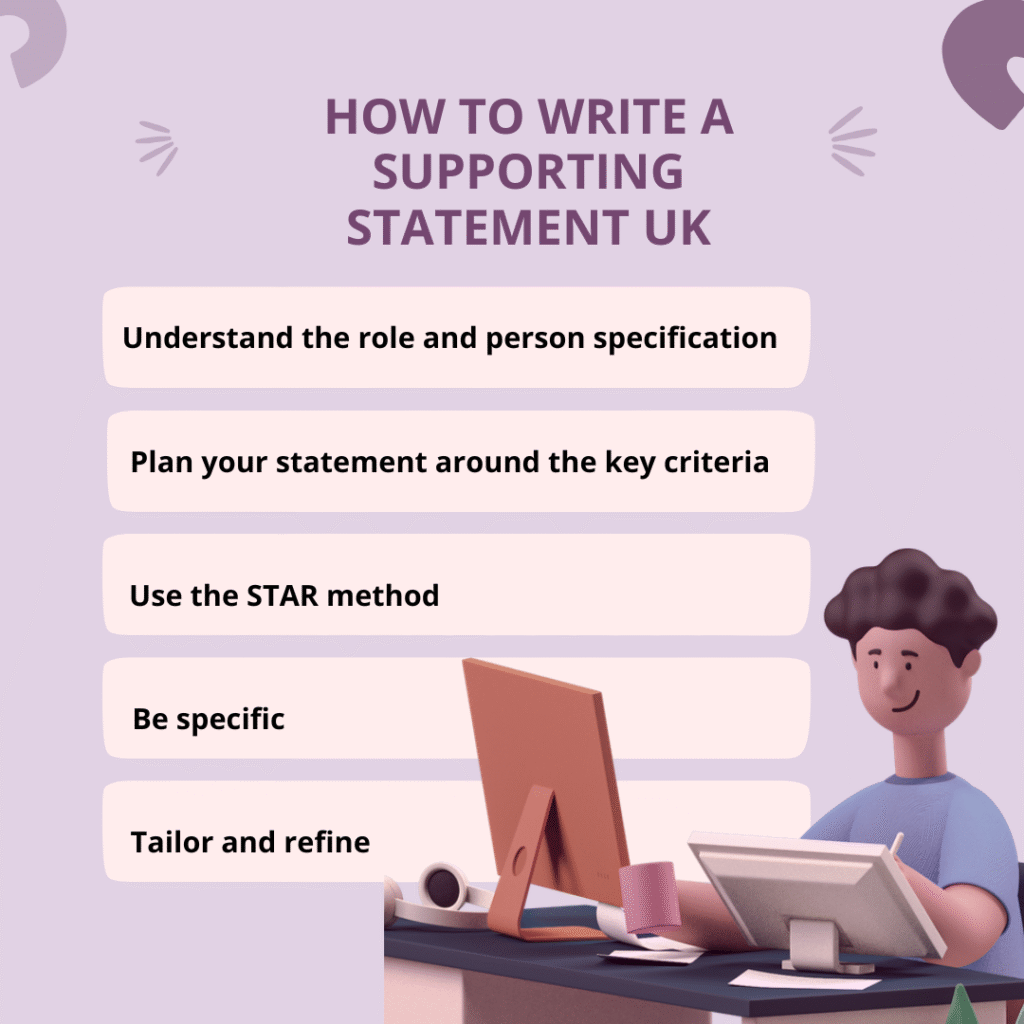
Step 1: Understand the role and person specification
Before you start writing, carefully review the job description and highlight the essential skills, qualifications and experience the employer is seeking. Then, think about your own experience and identify examples that align with each requirement.
To make your examples stand out, use the same language as the employer. This helps them spot relevant evidence and improves your chances of passing automated applicant tracking systems (ATS). Using supporting statement examples from similar roles can also guide you.
Step 2: Plan your statement around the key criteria
Group the person specification into sections, such as Education, Skills, or Experience, and plan one or two examples for each. If some criteria are closely related, you can combine them in one example, but make it clear how each requirement is met.
Step 3: Use the STAR method to structure your examples
To provide compelling evidence, structure your examples using the STAR method. Reviewing supporting statement examples can show you how to apply STAR effectively.
- Situation – the context or challenge you faced.
- Task – the responsibility you had.
- Action – the steps you took and why.
- Result – the outcome, ideally with measurable impact.
Supporting statement examples written with STAR show not just what you did, but how and why it mattered.
Step 4: Be specific and concise
A strong supporting statement avoids vague statements like “I have strong communication skills.” Instead, it demonstrates this through an example, such as leading a team presentation that improved project delivery times by 15%.
Keep your statement concise. Generally one to two paragraphs for CV summaries and slightly longer for separate supporting statements.
Step 5: Tailor and refine
Each supporting statement should be tailored to the specific job and organisation. Highlight your enthusiasm, reference the company by name when possible, and proofread carefully for grammar and spelling.
Getting feedback from a friend or mentor can also help ensure your supporting statement examples are clear, relevant, and compelling.
Understanding the person specification
The person specification is a list of the skills, qualifications, and experience the employer wants for the role. It tells you exactly what they are looking for in a candidate. By carefully reading it, you can identify the key areas to focus on in your supporting statement.
Break the specification into sections, such as Education, Skills, or Experience, and think of one or two examples from your own background that match each section.
By fully understanding the person specification, you ensure that your supporting statement is focused, relevant, and tailored to what the employer really wants.
Using STAR to structure your examples
Once you’ve carefully reviewed the person specification and identified the key skills, qualifications, and experience the employer is looking for. The next step is to structure your examples effectively. One of the most widely recommended ways to create a strong supporting statement example is by using the STAR method.

STAR stands for:
- Situation – Briefly explain the context or challenge you faced.
- Task – Describe your specific responsibility or objective in that situation.
- Action – Outline the steps you took to address the task, highlighting your skills and reasoning.
- Result – Show the outcome of your actions, ideally with measurable impact or clear benefits.
By using STAR, you ensure that your examples are detailed yet focused, demonstrating not just what you did, but how and why it mattered. This approach makes it easier for recruiters to see your skills in action and understand the value you could bring to their organisation.
How to use STAR
Instead of simply stating that you “improved customer service,” a STAR-based supporting statement example might look like this:
- Situation: Our customer support team was receiving frequent complaints about delayed responses.
- Task: I was tasked with reducing response times and improving satisfaction.
- Action: I created a tracking spreadsheet, prioritised queries, and coordinated with team members to ensure timely replies.
- Result: Customer response times were halved, and satisfaction scores increased by 25%.
Using STAR consistently across your supporting statement allows you to provide concrete evidence. A structured, evidence-based method like STAR is exactlly what recruiters expect to see in a supporting statement for job application submissions.
How to match your experience to the role
With your supporting statement now structured using STAR, the next step is to make sure it directly matches the role you’re applying for:
- Review the job description and person specification carefully.
- Ensure your supporting statement clearly demonstrates your skills, experience, and achievements while addressing the person specification. This forms a strong supporting statement example.
- Use the same language as the employer wherever possible to make it easier for recruiters to see that you meet their criteria.
- Focus on concrete achievements, showing not just what you did, but the impact it had.
When all these points are covered, your statement becomes a compelling supporting statement example that recruiters can quickly understand and appreciate.
Supporting Statement Examples for UK Job Applications
After structuring your experience to match the role using STAR, the next step is to see how this looks in practice.
These supporting statement examples show how to present skills clearly and persuasively.
Admin Roles Examples
In my previous role in an administrative team, I supported daily office operations, including managing correspondence, maintaining records, and coordinating schedules. Recognising inefficiencies in how documents were organised, I introduced a digital filing system and trained colleagues on its use. These changes reduced retrieval time by 50% and improved overall team efficiency. My organisational skills and experience in streamlining office processes enable me to contribute effectively to your team.
Project Support / PMO Examples
As a Project Support Officer at ABC Consulting, I was responsible for maintaining project documentation and supporting the delivery of multiple projects simultaneously. One particular project faced delays due to inconsistent reporting and missing documentation, so I created a centralised project tracker, standardised reporting templates, and introduced weekly progress updates for stakeholders. This improved project visibility and reduced reporting errors by 75%, ensuring that deadlines were met and stakeholder satisfaction increased. The proactive approach and attention to detail I applied in this role are qualities I am eager to bring to your PMO team.
NHS Band 3–5 Roles Examples
During my time as a healthcare support professional, I managed patient records and coordinated appointments, contributing to a 20% reduction in administrative delays. Collaboration with nurses and clinical staff helped streamline ward operations, ensuring all equipment and supplies were available, which improved patient flow and staff efficiency. Additionally, I trained new team members on hygiene protocols and electronic record systems, enhancing compliance with safety standards. Passionate about delivering high-quality care, I thrive in collaborative environments, making me well-prepared to contribute effectively to your team and support the NHS’s commitment to patient-centred care.
Customer Service Roles Examples
As a customer service representative, I consistently achieved a 95% customer satisfaction rating by resolving queries quickly and efficiently, often exceeding daily performance targets. Implementation of a feedback system identified recurring issues, resulting in a 15% reduction in repeat complaints over six months. Skilled at handling challenging situations with patience and professionalism, I build rapport with customers and foster loyalty. Thriving in fast-paced, team-oriented environments, I am committed to delivering exceptional service that aligns with company values and enhances the overall customer experience.
Common Mistakes to Avoid in Your Supporting Statement
Even with supporting statement examples available online, many applicants still make mistakes that could reduce their chances of getting past the first stage of recruitment.
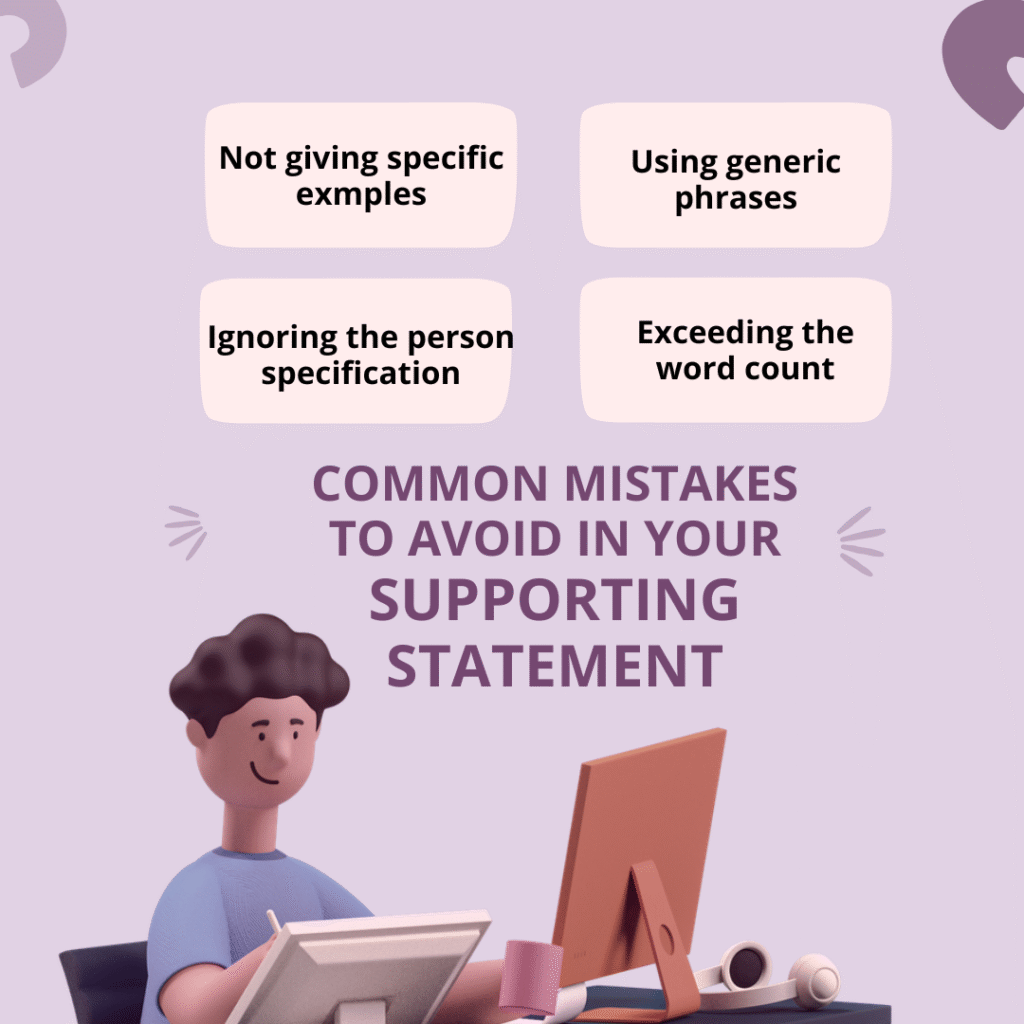
These errors can stop a strong CV from making an impact. Some of the most common mistakes are:
- Not giving specific examples – Simply saying you have a skill isn’t enough. Recruiters want to see real situations where you used that skill and the results you achieved.
- Using generic phrases – Phrases like “I’m a team player” or “I work hard” without showing evidence don’t make your statement stand out. Show your impact instead.
- Ignoring the person specification – Each job has a list of qualities and skills required. Failing to address these shows you haven’t tailored your statement to the role.
- Exceeding the word count – Going over the limit can make your statement seem unfocused. Stick to the required length while keeping your points clear.
By understanding these mistakes, you can write a supporting statement that clearly shows your skills, proves your achievements, and grabs the recruiter’s attention.
Being Too Generic
Many people make the mistake of using generic phrases like “I’m hardworking” or “I work well in a team.” These statements don’t give the reader a clear idea of what you actually do or what you’ve achieved.
Instead, pick one or two skills and show them in action with a short example. For instance, instead of just saying you’re organized, you could mention a project you managed successfully and the results it achieved.
Supporting statement examples with specific evidence make your statement stronger and help you stand out from other candidates.
Repeating your CV
Your supporting statement shouldn’t just repeat your CV. It’s your chance to show the how and why behind your experience. Instead of listing that you managed a team of five, explain how you coordinated tasks, resolved conflicts, and delivered results with concrete examples.
Employers want to see your skills in action, so highlight achievements, challenges you overcame, and the impact you made. Good supporting statement examples should tailor each statement to the role by referencing the job description.
Failing to Show Measurable Results
Employers want proof that your actions made a real impact, not just a list of duties.
Instead of saying you “managed a project” or “led a team,” include concrete metrics. For example, you could write that you “increased customer satisfaction scores by 15 percent over six months through targeted process improvements.”
These supporting statement examples show your effectiveness and make your contributions clear and memorable, helping you stand out from candidates who use generic descriptions.
Tips to Make Your Supporting Statement Stand Out
To catch a recruiter’s eye, focus on being specific and relevant. Start by tailoring each statement to the job you are applying for. At the same time, mention the company by name and show that you understand what they do.
Also, include concrete examples of your achievements, using numbers or results whenever possible (reference supporting statement examples to see how measurable results are presented).
Highlight how your skills and experience match the job requirements and explain how you can contribute to the company’s success. Keep it concise, clear, and enthusiastic to make a strong impression on recruiters.
Writing with Impact and Clarity
Once you’ve tailored your examples to the job, focus on writing clearly and persuasively. Strong supporting statement examples often keep sentences concise, use active verbs, and quantify achievements when possible.
For example, “Improved customer service response times by 25% by streamlining our ticketing system.”
Using Keywords from the Job Advert
Use the job advert’s keywords to show both ATS and recruiters that you match the role. Highlight recurring skills or action verbs like “project management” or “data analysis” and include them naturally with examples.
For instance, describe a project where teamwork or problem-solving led to measurable results. This makes your supporting statement relevant, persuasive, and tailored to the role.
Tailoring Your Tone to the Role
After including keywords from the job advert, adjust your tone to match the role. Creative roles may allow a friendly, enthusiastic style, while corporate or healthcare positions often require a professional, formal approach.
Tone is not just about word choice. It is also how you present achievements. Use confident, active language without exaggerating, and reference the employer and role to show you have researched their priorities.
Supporting statement examples that adapt your tone show you have the right skills, understand the workplace culture, and can contribute positively to the team.
Read Also:
- How to Write Mail for Job Application – Learn how to craft professional and compelling job application emails that grab recruiters’ attention.
- How to Use a Recruitment Agency to Find a Job – Discover how recruitment agencies can help you find the right opportunities and submit your applications effectively.
In short, a strong supporting statement can make your application stand out and showcase your value. At RKY Careers, we help you craft compelling statements, optimise your CV, and prepare for interviews. And with ApplyBuddy, our platform applies for jobs on your behalf, streamlining your job search effortlessly.
Frequently asked questions
What is the ideal length of a supporting statement for UK jobs?
Strong supporting statement examples aim for one to two short paragraphs or around 500–1,500 words depending on the employer’s instructions.
Should I use bullet points or paragraphs in a supporting statement?
Most strong supporting statement examples use clear paragraphs unless the employer specifically asks for bullet points.
Can I reuse the same supporting statement for different job applications?
You can adapt it, but always tailor each statement to match the specific job and employer. Doing so ensures you have a strong supporting statement example for each application.
How do I end a supporting statement professionally?
Supporting statement examples usually end with a positive summary of your skills and how you plan to contribute to the organisation.